A Business Case for Mission-Driven Work: RPM Team Featured in Offsite Builder
Read the full article in the May 2026 issue of Offsite Builder here: https://offsitebuilder.com/a-business-case-for-mission-driven-work
Why we invest pro bono hours into nonprofit housing projects, and how our business structure makes it possible.
In the architecture and engineering sectors, the term "mission-driven" is frequently used as a buzzword. But how is it practically sustained on a balance sheet?
Recently, Offsite Builder magazine explored this exact dynamic in their May 2026 issue, featuring RPM Team in an article titled "A Business Case for Mission-Driven Work". The piece captures the core philosophy of how we operate: balancing the rigorous demands of private and federal contracts with the deep need for rapidly deployable community housing.
The Reality of Funding (and Why We Step In)
One of the biggest hurdles for nonprofits in the housing space is the "chicken-or-egg" nature of grant funding. To win a grant, organizations must provide accurate budgets, but it's impossible to produce a budget without first understanding program requirements and conceptualizing floor plans and elevations.
As our President, David Renard, shared in the piece, RPM Team takes a different approach to this risk. We frequently work pro bono with nonprofits to help them conceptualize and create drawings, quickly converting their needs, wishes, and desires into actionable concepts and turnkey estimates. Even knowing that these organizations only win the grant about 15% of the time, we view this upfront work as an essential investment in the communities we serve.
Balancing the Mission with the Math
How do we afford to take on that level of risk? The answer is structural. RPM Team is not investor-led, which allows us the freedom to choose to pursue projects that prioritize human impact.
We rely on the strength of our diverse portfolio to support these initiatives. As David noted in the article, "This side of the business improves people's lives... Our government and military work is profitable, and that allows us to make these mission-focused decisions".
Solving Impossible Puzzles
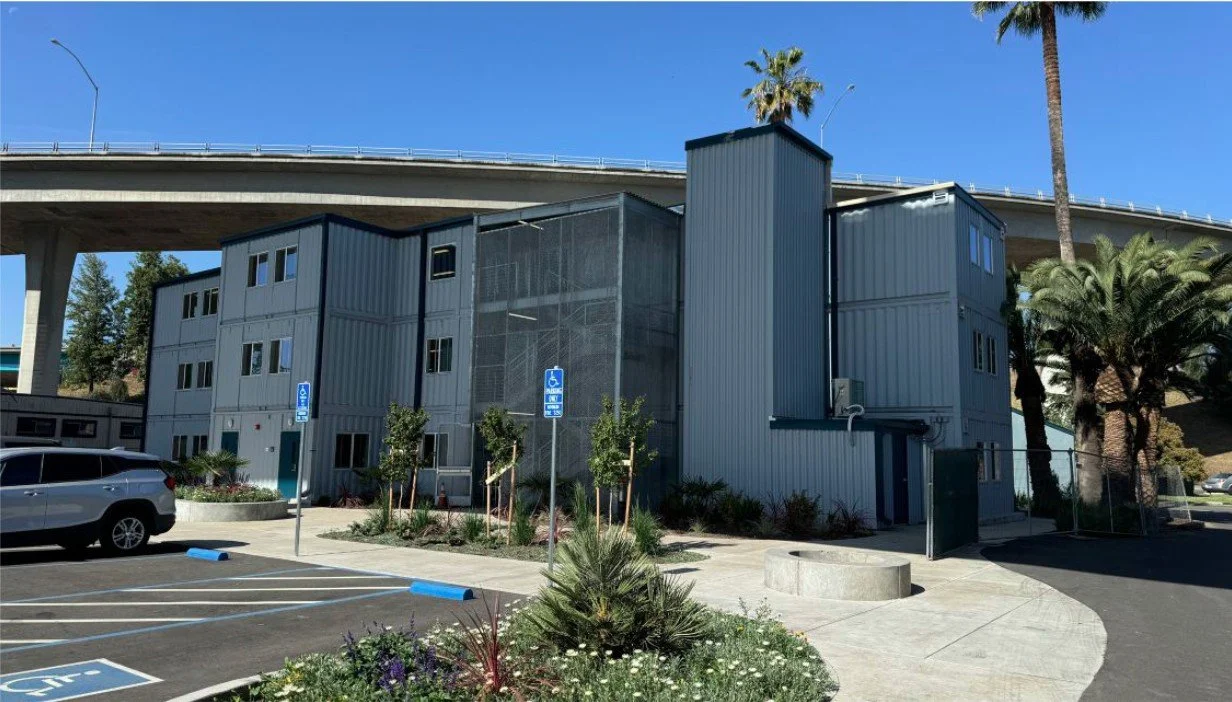
The feature also spotlighted how we apply our rapid, pre-engineered methodologies to highly constrained sites. For example, our Stockton project was tucked between two highway overpasses with only 13,000 square feet of buildable space, yet the grant mandated at least 150 beds. By leveraging modular construction, our team designed and managed the construction of a three-story, 11,000-square-foot facility to meet those exact needs. The article also highlighted our work on the Family Village in Glendale, Arizona—a six-unit micro-housing community providing supportive housing for families that have lost their homes.
Bridging Compassion and Construction
Finally, the article touches on the realities of working with mission-driven clients. The professionals in this sector bring incredible, necessary insight regarding trauma-informed design, safety, and resident needs. Our job is to bridge that essential knowledge with the hard realities of permitting, engineering phases, and aggressive timelines. Through consistent communication and our educational newsletter, we try to ensure our partners are empowered to navigate the complexities of fast-paced construction and modular constraints.
We are grateful to Offsite Builder for shining a light on the intersection of business and purpose in the modular construction space.
